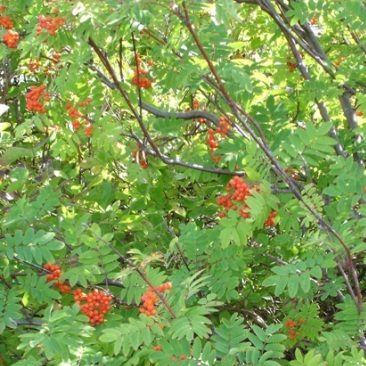
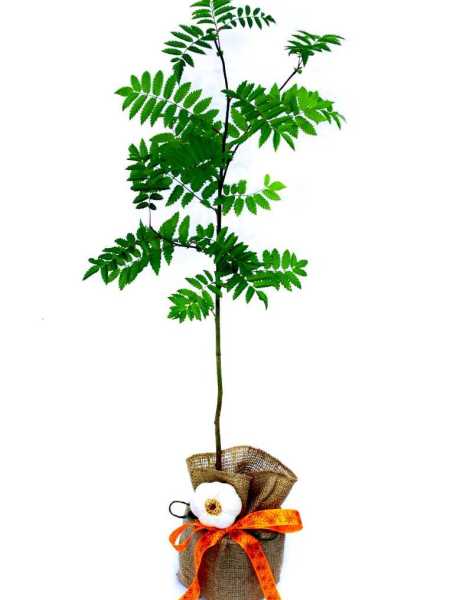
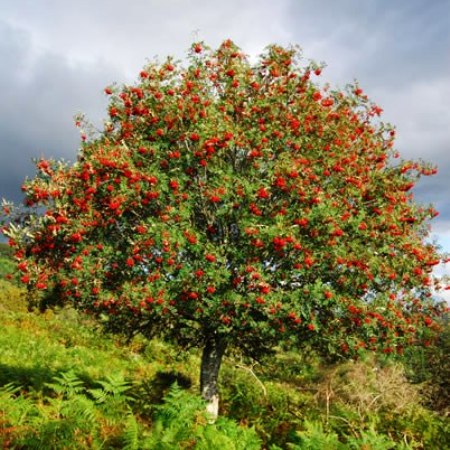
The Rowan tree is an elegant tree with delicate green leaves bearing clusters of creamy white flowers in spring and bright red berries in autumn, loved by birds. Suitable for most gardens. Fully hardy, it likes sun or semi-shade and most soils.
‘Sorbus aucuparia’ The Tree of Good Luck, January 21st – February 17th
The Lady of the Mountain, the Rowan is a welcome sight on the mountains of the British Isles and Ireland. The Ancients regarded it as the Tree of Life.
In May the Rowan produces a mass of creamy white blossom, the tiny flower has 5 petals and 5 sepals. The green fruit ripens to a deep orange-red in autumn. Each berry has a tiny 5-pointed star – the pentagram, an ancient symbol of magical protection. The number 5 is one of the numbers associated with the White goddess and to the Celts, this fivefold division marked the rowan as one of her sacred trees. Sorbus is the symbol of the hidden mysteries of nature and the quickening of the life force.
A sacred and magical tree, the Rowan offered many kinds of protection against enchantment and illness, and it was considered most unlucky to fall one. It was associated with visions and portents, with vitality, reawakening and spiritual strength. Serpents and dragons were part of the myth especially in the protection of the earth’s energies, in ley lines and standing stones. The Druids often planted Rowans at places of worship and they used the smoke from rowan fires to call up spirit guides and warriors. The smoke was also traditionally used to foretell the future of lovers. It is said that wherever druidic remains are found so also are Rowan trees.
The Rowan is under the planetary influence of the sun and is strongly associated with two ancient sun goddesses, Brigid of Ireland and Brigantia of England. Both the headed river and water cults protected pastoral people and their flocks and herds. From Brigid comes the divine inspiration behind poetry, music and the arts.
The Rowan is a slender tree with smooth grey bark and elegant, upward-reaching branches. Surprisingly it is a member of the Rose family. This tree is as happy growing on an exposed hill as it is on lowland heath and pasture.
Rowan blossom announces the return of the young goddesses in the spring mountainside and is associated with fertility. This is especially enhanced in autumn when the songbirds are attracted by the berries. In autumn, the leaves change from green to shades of pink and gold. Sometimes the berries remain after the leaves have fallen, this depends on the birds who love the berries which are a good source of food for them.
In Wales, Rowan trees were planted in churchyards to protect the spirits, while a Cross of Rowan
twigs tied with red ribbon was said to offer protection from witches at Hallowe’en.
Boughs of Rowans are still hung over stables in many parts of Britain to protect livestock from barrenness and harm.
A Rowan tree will protect the home from storms and lightning and guard against witches
and other bad folks. It is truly a special tree and every home should have one.
Colour Green, Planet the Sun, Stone Tourmaline, Polarity Feminine,
Deities Brigantia, Bridgid, Virgin Mary.
Quickening + Sacred Fire, Vitality + Spiritual Strength, + Creative Inspiration



 Attracts
 Blossom Colour
 Flowering Period
 Habit (Shape)
 Height (when grown)
 Hardiness
 Leaf Colour
 Lighting
 Position
 Soil Type